
Customer Success Stories
Feb 1, 2023
Jul 2, 2026
•
11 min read
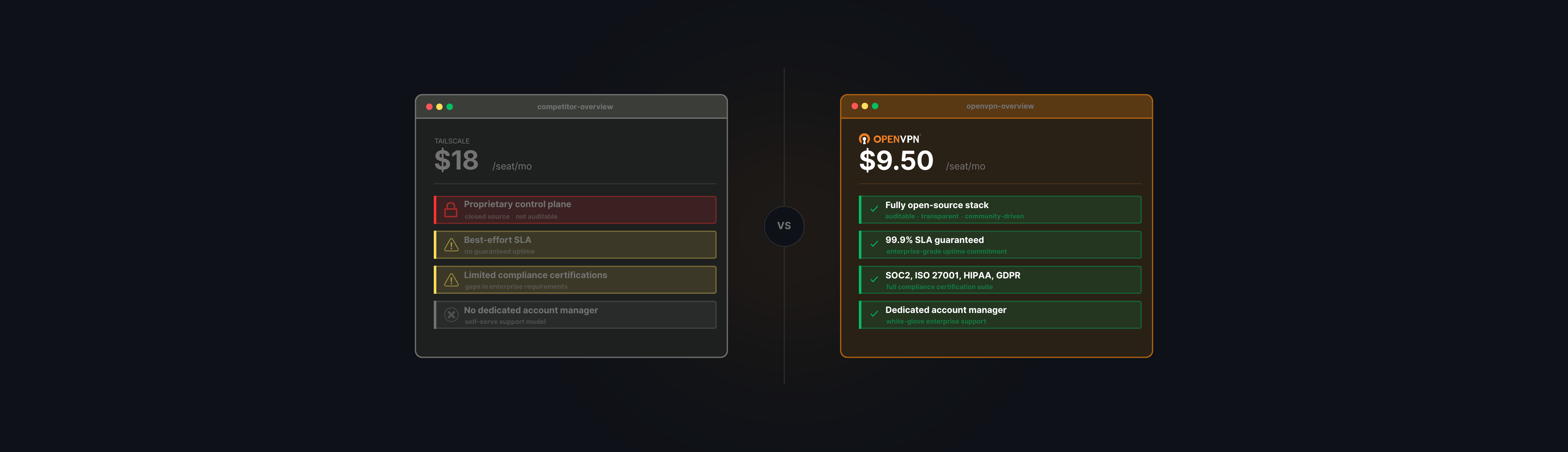
CloudConnexa and Tailscale both solve the problem of how to connect distributed teams and infrastructure, but they take different approaches to get there. This breakdown covers architecture, zero-trust controls, secure internet access, and observability, so you can match the right tool to your environment.
CloudConnexa overview
OpenVPN CloudConnexa is a cloud-delivered network security platform that unifies ZTNA (private application access), secure internet access (content filtering, IDS/IPS), SaaS protection, and site-to-site connectivity into a single service. It is built around OpenVPN's "Wide-area Private Cloud" (WPC) model: an overlay private network spanning CloudConnexa’s Points of Presence, through which customers connect their networks via software Connectors that require no inbound ports and their devices via the OpenVPN Connect client, while OpenVPN operates the control and data planes. It uses OpenVPN Data Channel Offload (DCO) for high performance and offers zero-trust controls based on identity, device, and location context. Client and device connections use the OpenVPN protocol, and IPsec is supported for site-to-site (Network Connector) connections. Its built-in Cyber Shield delivers content filtering and IDS/IPS, and the service is SOC 2 Type 2 and ISO/IEC 27001 certified.
Tailscale overview
Tailscale is a cloud-operated, WireGuard-based mesh VPN that splits a hub-and-spoke coordination plane (operated by Tailscale) from a peer-to-peer data plane that carries traffic directly between devices. Every participating node runs the Tailscale agent; there is no agentless or clientless option for end devices. The vendor operates a global fleet of DERP relays for NAT traversal and as a fallback when direct peer-to-peer paths cannot be formed, and traffic stays end-to-end encrypted such that relays cannot decrypt it. Access is governed by an identity-based, default-deny ACL policy file (JSON), with strengths in policy-as-code, Tailscale SSH, MagicDNS, device-posture integrations, and Tailnet Lock. It is fundamentally a connectivity/ZTNA mesh rather than a traffic-inspection security stack: it offers no native Secure Web Gateway, content filtering, IDS/IPS, CASB, or malware inspection, providing DNS filtering only through integrations such as NextDNS or Control D. Several enterprise capabilities — log streaming, custom device-posture attributes, and third-party EDR/MDM posture — are gated to paid/top tiers.
When to Choose CloudConnexa vs. Tailscale
Choose CloudConnexa if you need built-in secure internet access (content filtering and IDS/IPS) alongside remote access and site-to-site in one service; if you need to reach devices that cannot run an agent (such as IoT or legacy systems) through managed Connectors; or if you require a single platform with centralized logging and SOC 2 Type 2, ISO 27001, and HIPAA alignment.
Choose Tailscale if every endpoint you need to connect can run its agent, you want a WireGuard peer-to-peer mesh with direct device-to-device paths, MagicDNS, Tailscale SSH, ACL policy-as-code (Terraform/GitOps), and third-party device-posture integrations, and you can provide security filtering (DNS/threat/IDS) through external tools — noting that log streaming and some posture features are limited to higher tiers.
Architectural trade-off
The two products use different connectivity models: CloudConnexa routes traffic through vendor-operated regional gateways, while Tailscale forms a peer-to-peer WireGuard mesh coordinated by a vendor-operated control plane that carries no traffic. The points below weigh that difference and test where common claims hold.
Where Tailscale's mesh architecture can help
- When two endpoints establish a direct path, traffic does not transit a central gateway, which can reduce latency for peer-to-peer flows.
- Direct-path throughput is bounded by the endpoints rather than by a gateway's capacity.
- New nodes join by authenticating to the coordination plane, so adding connectivity does not require provisioning regional gateways.
- The coordination plane holds no traffic and cannot decrypt it, which limits what a control-plane compromise exposes.
Trade-offs and claim-vs-reality
- The claim that mesh traffic is "fast because it is direct" holds only when NAT traversal succeeds; symmetric NAT, carrier-grade NAT, and UDP-blocking firewalls force a fallback to relays (DERP), which adds a hop and lowers throughput — so the benefit depends on what share of devices sit behind hard-to-traverse NAT.
- An agent is required on every node, so devices that cannot run it (printers, IoT, appliances) are reachable only via subnet routers, which reintroduces a gateway hop for those devices.
- There is no inline traffic inspection (no SWG, IDS/IPS, or malware scanning) because end-to-end encryption prevents it; those controls must be added separately.
- Per-node peer and route state grows with network size, and OS-level limits (routing-table size, mobile memory limits) can constrain very large meshes.
- Visibility is distributed rather than centralized; per-flow logging depends on enabling and exporting flow logs, with log streaming limited to higher tiers.
Feature comparison
Architecture & Deployment Model
|
Capability |
CloudConnexa |
Tailscale |
|
Cloud-hosted control plane |
Yes — OpenVPN operates control + data plane (WPC) |
Yes — vendor-operated coordination server (carries no data) |
|
Data plane |
Routed through managed Regions; full-mesh core |
Peer-to-peer WireGuard mesh; DERP [1]/peer relays for NAT traversal and fallback |
|
Multiple isolated overlay networks |
Yes — multiple isolated WPCs per account (segment OT, IoT, and IT networks) |
No — one tailnet per account; isolation requires separate tailnets/accounts |
|
Connection model |
Devices via OpenVPN Connect; networks via Connectors |
Agent required on every node; subnet routers [10]/app connectors [9] for networks |
|
Reaching non-mesh networks |
Network and Host Connectors |
Subnet routers [10] (agent on a gateway); app connectors [9] (domain-based) |
|
Regions / relay coverage |
~36 Regions worldwide |
Global DERP [1] relay fleet operated by Tailscale |
|
Client platforms |
Windows, macOS, iOS, Android, ChromeOS; Linux via openvpn3 |
Windows, macOS, Linux, iOS, Android (agent required everywhere) |
Administration & Management
|
Capability |
CloudConnexa |
Tailscale |
|
Web admin console |
Yes — Administration Portal; Owner/Admin/Member roles |
Yes — admin console with granular roles |
|
Public API |
Yes — REST API with OAuth 2.0 |
Yes — full tailnet/device/key/policy API |
|
Infrastructure-as-code |
Yes — Terraform provider |
Yes — official Terraform provider; GitOps for ACLs |
|
Policy-as-code |
Access Groups via portal/API/Terraform |
Yes — JSON/HuJSON tailnet policy file |
|
Provisioning |
Manual, API, SCIM 2.0 |
Auth keys, ephemeral/tagged nodes [12]; SCIM. |
|
Device management |
Device allowance, trusted devices, device identity enforcement, and connection profiles imported after login. |
Machines page; authorize/deauthorize; posture status |
Zero Trust & Identity
|
Capability |
CloudConnexa |
Tailscale |
|
Access model |
Access Groups control access to the destination application and IP services based on source identity. Includes Network-to-application and Network-to-Network access control. |
Identity-based, default-deny ACL/grants by user, group, tag, CIDR |
|
User authentication |
Local username/password, LDAP, SAML 2.0 |
SAML/OIDC via IdP; no local password store |
|
Simultaneous IdP + local auth |
Yes — SAML and local accounts usable at the same time |
Partial — IdP-based; no local password store |
|
Multiple group membership per user |
Yes — one Primary plus up to 20 Secondary user groups (additive) |
Yes — ACL groups (additive) |
|
MFA |
Built-in 2FA; passkey/passwordless. Delegated to IdP when SAML is used. |
Delegated to your IdP (Tailscale is not an IdP) |
|
Device posture / compliance |
Yes — OS, antivirus, disk encryption, certificate |
Native OS attributes; EDR/MDM (CrowdStrike, SentinelOne, Intune, Jamf) (not available in all plans); custom attributes (not available in all plans) |
|
Location / geo context |
Yes — allow/block by IP range or country |
Partial — geolocation via device posture (not available in all plans) |
|
SCIM provisioning |
Yes — SCIM 2.0 (not available in all plans) |
Yes |
|
Service / non-human identity |
Host Connectors; REST API (OAuth client credentials) |
Tagged/ephemeral nodes [12]; auth keys; OAuth clients |
|
Device / supply-chain trust |
Device Identity Verification & Enforcement (locks profile to device) |
Yes — Tailnet Lock [4] (node-key co-signing) |
Access Use Cases
|
Capability |
CloudConnexa |
Tailscale |
|
Remote access |
Yes — core use case |
Yes — core use case |
|
Site-to-site |
Yes — via Network Connectors (IPsec or OpenVPN) and IPsec/OpenVPN-compatible routers. |
Yes — subnet routers [10]/dedicated site-to-site mode |
|
Internet egress |
Yes — any Network as Internet Gateway; smart geo-routing |
Yes — exit nodes [11] |
|
Selective SaaS routing by domain (split tunnel on) |
Yes — route specific SaaS domains through a chosen Internet Gateway with split tunnel ON (no full tunnel required) |
Yes — app connectors route specified SaaS domains via a chosen node |
|
Vendor-provided static egress IP |
No — the customer runs the Internet Gateway and supplies the public IP |
No — egress IP is a self-run exit node's host IP |
|
Cloud connectivity (AWS/Azure/GCP) |
Yes — native Connectors; plus VPS and routers |
Subnet routers [10] + Kubernetes operator |
|
SSH access |
Via application/IP service access controls |
Tailscale SSH [5] (cert-free, ACL-governed) |
|
Public (internet) ingress |
Not offered — private-access focus |
Funnel [6] |
|
Private / tailnet ingress |
Private app access via Access Groups; AppHub for cross-WPC sharing |
Serve [7] |
|
Clientless end-user access |
Not offered (client-based) |
Not offered — agent required on every endpoint |
Networking
|
Capability |
CloudConnexa |
Tailscale |
|
Client/device protocol |
OpenVPN only; OpenVPN Data Channel Offload (DCO) for throughput |
WireGuard (userspace wireguard-go) |
|
WireGuard |
No — not supported for any connection type |
Yes — WireGuard is the foundation |
|
Site-to-site protocol |
OpenVPN; IPsec (site-to-site networks only) |
WireGuard throughout; subnet routing [10] |
|
Name resolution |
DNS Proxy; custom zones, built-in DNS records |
MagicDNS [3] |
|
Split / conditional DNS |
Custom DNS records/zones |
Split DNS and force-tailnet DNS override |
|
NAT traversal |
Managed by hosted gateways |
DISCO [2] + DERP [1] coordination for direct P2P |
|
Overlapping subnet handling |
Domain-based routing handles overlapping IPs |
4via6 [8] disambiguation |
|
IPv6 addressing |
IPv4 and IPv6 supported |
ULA IPv6 address per node |
Secure Internet Access
|
Capability |
CloudConnexa |
Tailscale |
|
Content / DNS filtering |
Yes — Cyber Shield Domain Filtering, 43 categories; included |
Not native — only via NextDNS/Control D integrations |
|
Secure web gateway (SWG) |
Yes — DNS Proxy + Cyber Shield Traffic Filtering |
No — not offered |
|
IDS / IPS |
Yes — Cyber Shield Traffic Filtering (monitor/block) |
No — not offered (E2E encryption precludes inline inspection) |
|
Malware inspection |
Yes — malware/threat protection built in |
No — not offered |
|
CASB/SaaS security |
Not offered (SaaS access can be restricted to an Internet Gateway egress IP) |
Not offered |
Observability & Operations
|
Capability |
CloudConnexa |
Tailscale |
|
Audit/config logging |
Yes — Audit Log of config changes; CSV export |
Yes — configuration audit logs |
|
Network flow logs |
Access Visibility and DNS Log |
Yes — network flow logs (must be enabled) |
|
SIEM/log streaming |
Yes — JSON streaming to AWS S3; Splunk, Datadog |
Splunk, Datadog, S3/GCS/Azure, more (not available in all plans) |
|
Session recording |
Not applicable |
SSH session recording [5] (not available in all plans) |
|
Alerts/events |
Yes — email alerts for usage, connector status |
Event webhooks; client metrics |
Reference: Tailscale named feature
Tailscale markets several capabilities under proprietary names. The numbers below are referenced in the comparison tables above (e.g. "MagicDNS [3]"). Each entry summarizes the function the named feature provides and the closest equivalent in CloudConnexa.
|
Feature |
What it does |
CloudConnexa equivalent |
|
Tailscale-operated encrypted relays (Designated Encrypted Relay for Packets) that coordinate NAT traversal and forward still end-to-end-encrypted traffic when a direct peer-to-peer path cannot be established. |
By design, all traffic is routed through OpenVPN-operated regional gateways/PoPs, so relaying is inherent to the managed data plane rather than a fallback. |
| 2. DISCO |
Tailscale's peer-discovery protocol that exchanges candidate endpoints so two nodes can negotiate a direct connection. |
Not applicable — clients connect to managed gateways instead of forming direct peer links, so NAT traversal is handled by the hosted service. |
| 3. MagicDNS |
Automatically assigns human-readable DNS names to every device in the tailnet so nodes are reachable by name. |
Built-in DNS Proxy with custom DNS records and application domain-based routing provides name-based access to resources. |
| 4. Tailnet Lock |
Supply-chain protection in which trusted nodes co-sign new device keys, so the coordination server cannot unilaterally add a device to the network. |
Device Identity Verification & Enforcement and trusted-device controls restrict which devices may connect. |
| 5. Tailscale SSH |
The agent brokers SSH connections governed by ACLs without the admin managing SSH keys, with optional session recording. |
SSH is reached as any other private service through application/IP-service access controls (no built-in key-brokering layer). |
| 6. Funnel |
Exposes a service running on a node to the public internet over HTTPS. |
No direct equivalent — CloudConnexa focuses on private access; AppHub shares private apps to other CloudConnexa accounts rather than publishing to the open internet. |
| 7. Serve |
Shares a service privately within the tailnet (not exposed publicly). |
Private application access via Access Groups and domain-based routing, with AppHub for cross-account sharing. |
| 8. 4via6 |
An addressing scheme that maps overlapping IPv4 subnets to unique IPv6 addresses so multiple sites using the same CIDR can be reached. |
Application domain-based routing natively connects networks with overlapping IP addresses. |
| 9. App connectors |
A node that routes access to specific SaaS or self-hosted apps by domain name rather than by IP. |
Application domain-based routing is built into the service. |
|
10. Subnet routers |
A node running the agent that advertises and bridges an entire subnet into the mesh so non-agent devices can be reached. |
Network Connectors expose a whole network; Host Connectors expose individual servers or devices. |
|
11. Exit nodes |
A designated node through which a device's internet-bound traffic is routed. |
Any Network can be set as an Internet Gateway, with smart geo-based routing. |
|
12. Tagged/ephemeral nodes |
Non-human identities: tags label servers/CI machines for ACL purposes, and ephemeral nodes are auto-removed after they disconnect. |
Host Connectors and API-based profile provisioning for unattended clients. Profiles (containing digital certificates) can be revoked by the API. |
Secure your network now.
Ready to take your business to the next level with CloudConnexa? Work from anywhere and from any device with confidence.