
Cybersecurity
Jun 25, 2026
Aug 13, 2026
•
3 min read
.png)
What is CVE-2026-20349? The Cisco ASA/FTD VPN flaw explained
On 2026-Aug-11, Cisco warned that CVE-2026-20349 — a flaw in the VPN web server of Secure Firewall ASA and FTD software — is being exploited in the wild. The vulnerability (CVSS 8.6) stems from insufficient error checking when processing HTTP requests: an unauthenticated attacker can send a crafted HTTP request to the Remote Access SSL VPN service and force the device to reload — no credentials, no user interaction.
CISA has added it to the Known Exploited Vulnerabilities catalog, giving US federal agencies until August 14, 2026 to remediate. That deadline is a useful benchmark for everyone else: if CISA wants it fixed in 72 hours, so should you.
Who is affected by this Cisco ASA vulnerability?
This Cisco ASA vulnerability affects devices running Secure Firewall ASA or FTD software with remote-access services enabled — including SSL VPN, IKEv2 remote access VPN with client services, and Zero Trust Network Access on FTD. If your workforce dials in through an ASA or FTD appliance, assume you're in scope until you've confirmed otherwise against Cisco's advisory.
How to fix CVE-2026-20349 right now
-
Patch. Cisco has released fixed software; the advisory lists fixed versions per release train. This is the fix — do it first.
-
Check exposure. If you can't patch immediately, review which remote-access services are listening on the outside interface and restrict where you can.
-
Watch for reloads. The observed exploitation causes device reboots — unexplained ASA/FTD reloads this week deserve investigation, not a shrug.
What happens to remote access while you patch?
Here's the operational trap this incident exposes: for most ASA/FTD shops, the appliance being attacked is also the only door into the network. While it's rebooting — from an exploit or from your own emergency maintenance window — nobody can get in. The team that needs remote access to fix the problem is locked out by the problem.
That's not a Cisco-specific failure. Every vendor ships vulnerabilities. It's an architecture failure: single-vendor, single-path remote access means any one CVE can take your whole remote workforce offline.
Vendor-diverse remote access: a disaster recovery layer for Cisco shops
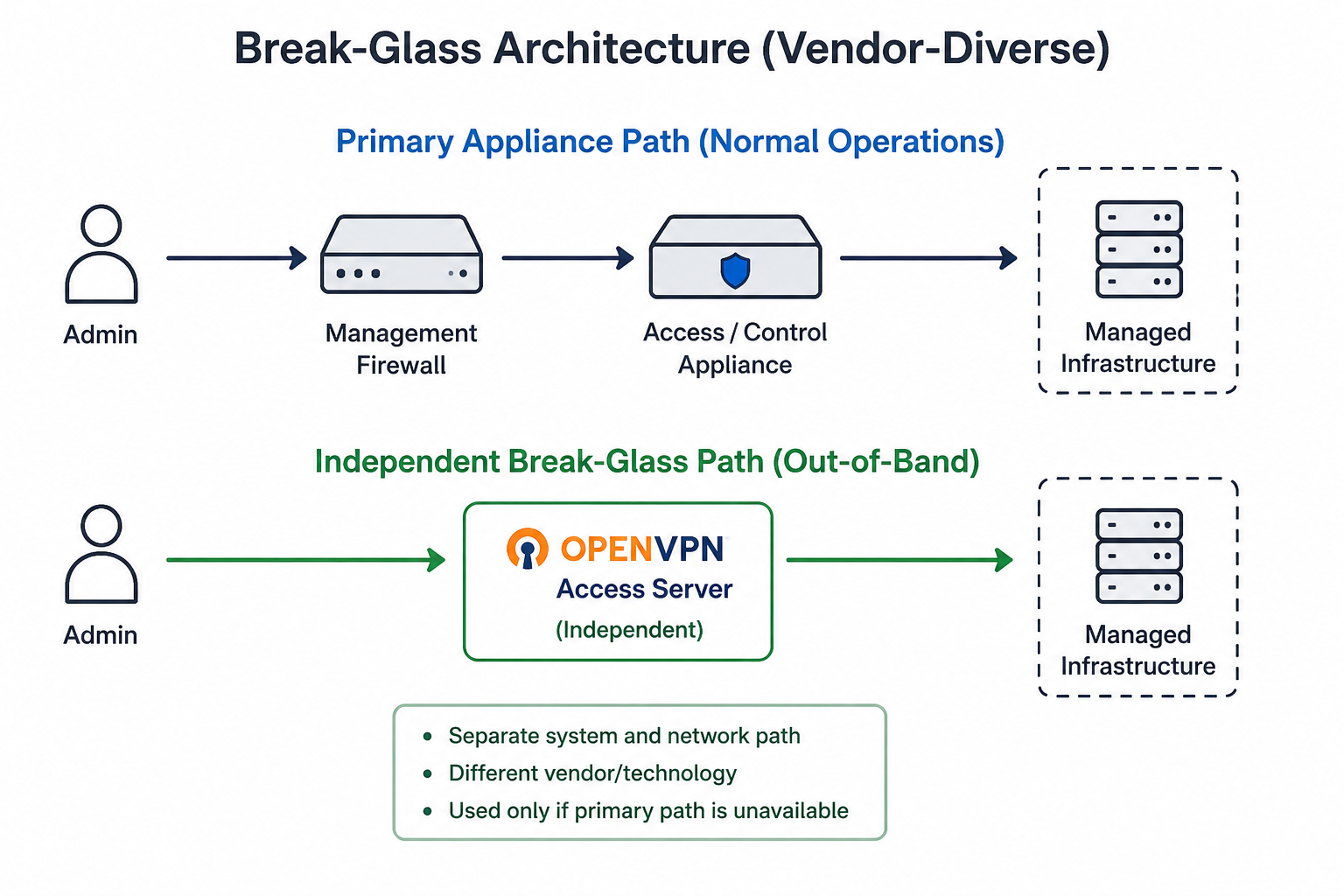
A backup remote-access layer on independent infrastructure and an independent codebase turns "the VPN is down" from an outage into a non-event:
OpenVPN Access Server: self-hosted, runs on your own VM or cloud instance, completely independent of your firewall appliance. Keep it warm with your admin group and break-glass profiles; scale licenses up only when you need to fail over the workforce.
CloudConnexa: cloud-delivered ZTNA if you'd rather not host the backup path yourself.
Either way, the point is supplier diversity for your most operationally critical service: when the primary path is under active exploitation — this week it's Cisco's turn, next quarter it may be anyone's — your people keep working and your admins keep administering.
FAQ: CVE-2026-20349
Is CVE-2026-20349 actively exploited?
Yes. Cisco PSIRT confirmed active exploitation in August 2026, and CISA added the flaw to its Known Exploited Vulnerabilities catalog with a 2026-Aug-14 remediation deadline for US federal agencies.
Which Cisco products are affected by CVE-2026-20349?
Cisco Secure Firewall ASA and FTD software with remote-access services enabled — SSL VPN, IKEv2 remote access VPN with client services, or Zero Trust Network Access on FTD. Check your exact version against Cisco's advisory.
Is there a patch for CVE-2026-20349?
Yes. Cisco has released fixed software versions, listed per release train in advisory cisco-sa-asaftd-vpn-dos-dzv4mQFF. Patching is the recommended remediation.
Does CVE-2026-20349 expose data?
The publicly documented impact is denial of service: a crafted HTTP request forces the device to reload, cutting off remote access. No data theft has been attributed to this flaw in public reporting — but a downed VPN concentrator is itself a business-continuity incident.