CloudConnexa
Aug 19, 2026
Aug 3, 2026
•
8 min read

Over this series, we've established what a WireGuard mesh-VPN is (Post 1), the technical/operational/security trade-offs (Post 2), and how each model holds up under compliance pressure (Post 3). Now let's make the decision practical. As an IT leader, you want a framework you can take to a whiteboard — and to your leadership.
What five environment questions should you ask first?
Your architecture should follow your environment, not the other way around. Answer these honestly:
- Agent coverage. Can nearly every endpoint run a client, or do printers, IoT, OT, and legacy systems make up a meaningful share? The more agentless devices, the more you'll lean on gateways either way — and the more a managed connector model helps.
- Operational capacity. Does your team have the bandwidth to deploy, patch, monitor, and secure a control plane (if self-hosting) or to assemble IDS/IPS, filtering, and SIEM around a mesh? Or is "fewer moving parts" worth more than fine-grained control?
- Security depth required. Is encryption-plus-ACLs sufficient, or do you need intrusion prevention, content filtering, and centralized retained logging as first-class features?
- Compliance exposure. Do HIPAA, PCI-DSS, or SOC 2 apply now or soon? Do you need a BAA or vendor attestation?
- Performance profile. Are there latency-critical, point-to-point workloads where a direct mesh path is a hard requirement?
When should you choose a WireGuard mesh-VPN?
Lean toward a WireGuard mesh-VPN if:
- Most or all endpoints can run an agent.
- You have engineering muscle and want control — policy-as-code, self-hosting, infrastructure-as-code.
- Your security needs are met by strong encryption and disciplined ACL segmentation, and you're comfortable adding logging/threat tooling yourself.
- Peak, low-latency direct-path performance between endpoints is a priority.
- You're unregulated, or your compliance needs are limited, and you have the discipline to evidence them.
When should you choose OpenVPN CloudConnexa?
Lean toward OpenVPN CloudConnexa if:
- You want a single, fully managed service with no control plane to operate.
- You need bundled secure internet access — built-in IDS/IPS and content filtering (Cyber Shield) — rather than assembling it.
- You have significant agentless or site-based connectivity needs best served by managed Connectors and IPsec site-to-site.
- You're regulated or facing security questionnaires, and value SOC 2 Type 2, ISO 27001, and HIPAA alignment plus centralized, exportable logs.
- Your team is lean and "one platform, one console, one bill of controls" reduces real operational risk.
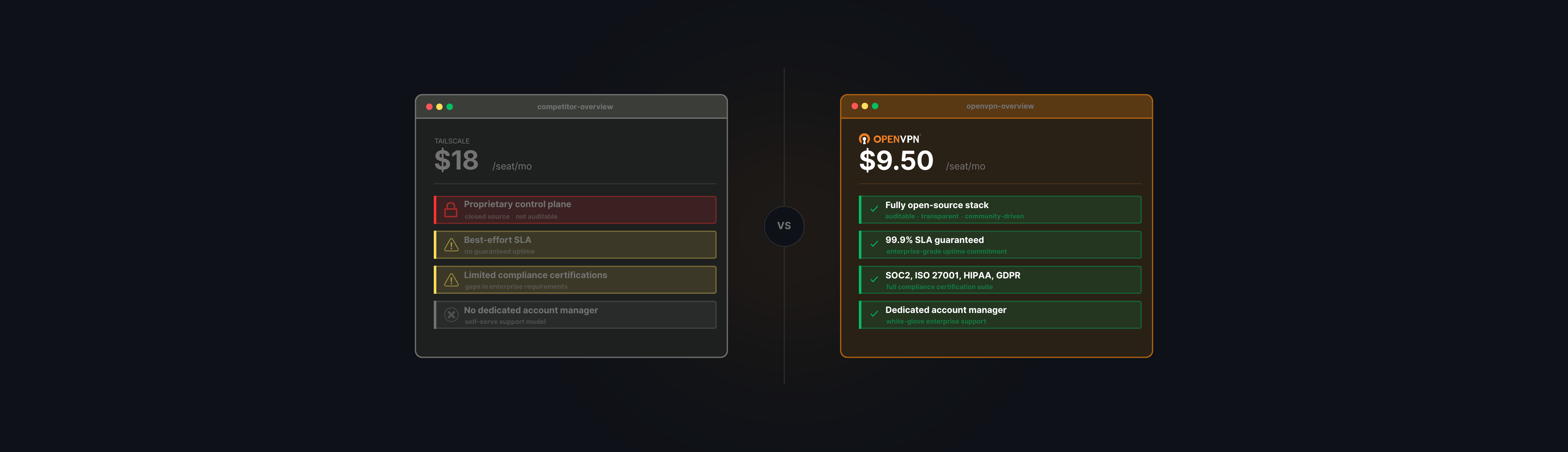
Mesh-VPN vs. CloudConnexa: an honest side-by-side comparison
This series has tried to be fair to both models. Here's the consolidated view.
|
Dimension |
WireGuard Mesh-VPN |
OpenVPN CloudConnexa |
|
Core philosophy |
Peer-to-peer overlay you assemble and govern |
Managed, all-in-one cloud network security service |
|
Underlying protocol |
WireGuard |
OpenVPN (clients); IPsec for site-to-site only; no WireGuard |
|
Data path |
Direct P2P when possible; relay fallback |
Through managed global data centers (Points of Presence)/full-mesh core |
|
Peak performance |
Excellent on direct paths |
Good; centralized routing adds hops; Data Channel Offload helps |
|
Agentless/legacy reach |
Subnet routers/site-to-site you build |
Managed Connectors + IPsec site-to-site |
|
Built-in security stack |
Encryption + ACLs; rest is DIY |
ZTNA + IDS/IPS + content filtering bundled |
|
Logging & observability |
Flow logs to your SIEM; depth varies |
Built-in access/DNS/audit logs + SIEM streaming |
|
Operational burden |
Higher (self-host) or vendor-hosted control plane |
Low — fully vendor-operated |
|
Compliance fit |
Building blocks; you assemble the program |
Attested service (SOC 2 Type 2, ISO 27001, HIPAA alignment) |
|
Best-fit buyer |
Technical teams, performance-first, control-first |
Lean/regulated SMBs wanting bundled, managed security |
Why is CloudConnexa often the pragmatic choice for SMBs?
For many small and mid-sized organizations, the binding constraint isn't whether mesh can be made secure and compliant — it can — but whether a small team can operate all the layers required to keep it that way, audit after audit, quarter after quarter. CloudConnexa is designed to collapse that operational surface:
- One service instead of a stack. Remote access, zero-trust application access, secure internet access, and site-to-site connectivity arrive together, managed from a single Administration Portal, with a REST API and Terraform support for automation.
- Security that's on by default. Cyber Shield's content filtering and IDS/IPS, device posture policies, SAML SSO, SCIM, and MFA are built in — the very controls a mesh expects you to add.
- Reach beyond agents. Connectors and IPsec site-to-site bring whole networks, cloud VPCs, and agentless devices into scope without you having to stand up and maintain gateway infrastructure.
- Evidence when you need it. Centralized access, DNS, and audit logs — with SIEM streaming and CSV export — make audits and security questionnaires far less painful.
- A trusted foundation. Built on the widely deployed, independently audited OpenVPN protocol, with OpenVPN operating the control and data plane and carrying its own SOC 2 Type 2 and ISO 27001 posture.
If your environment is technical, performance-obsessed, and you genuinely want to own the architecture, a mesh-VPN may be the better tool — and you should choose it with confidence. But if you're a lean or regulated SMB that needs strong security and low operational drag, the all-in-one, managed model is usually the choice you won't have to revisit.
Final decision checklist
☐ I've mapped agent coverage and know my agentless-device burden.
☐ I've honestly assessed my team's capacity to operate a control plane and/or assemble a security stack.
☐ I know which compliance frameworks apply and what evidence they demand.
☐ I've decided whether I need IDS/IPS and content filtering as built-in features.
☐ I've weighed peak direct-path performance against consistent, managed delivery.
☐ I can articulate, in one sentence, why my chosen architecture fits my environment.
If that last sentence comes out as "We have the engineering depth and want full control over a high-performance overlay," a mesh-VPN is your path. If it comes out as "We need comprehensive, compliant security with minimal operational overhead," take a serious look at OpenVPN CloudConnexa — and start with a trial against your real environment.
Frequently Asked Questions
What's the difference between a WireGuard mesh-VPN and OpenVPN CloudConnexa?
A WireGuard mesh-VPN is a peer-to-peer overlay you assemble and govern yourself, with identity, logging, and threat inspection added separately. OpenVPN CloudConnexa is a fully managed cloud service that bundles remote access, zero-trust application access, and secure internet access (IDS/IPS plus content filtering) into one hosted control and data plane, so there's no coordination server for your team to run.
How do I decide between a mesh-VPN and a managed VPN like CloudConnexa?
Score your environment against five factors: agent coverage across endpoints, your team's operational capacity to run a control plane or assemble a security stack, how much built-in security depth you need, your current and near-term compliance exposure, and whether peak direct-path performance is a hard requirement. Teams strong on engineering capacity and control tend toward mesh; lean or regulated teams tend toward CloudConnexa.
Is a mesh-VPN or CloudConnexa better for a regulated SMB?
Regulated SMBs — those facing HIPAA, PCI-DSS, or SOC 2 — generally do better with a managed, attested platform. CloudConnexa carries its own SOC 2 Type 2, ISO 27001, and HIPAA alignment and ships centralized, exportable logs, which simplifies audits compared with assembling that evidence around a self-managed mesh. See Post 3 for the full compliance breakdown.
Does OpenVPN CloudConnexa use WireGuard?
No. CloudConnexa uses the OpenVPN protocol for client and device connections and supports IPsec only for site-to-site (network-to-network) connections; it does not use WireGuard for any connection type. See Post 1 for the full protocol comparison.
What is the biggest operational difference between mesh-VPN and CloudConnexa?
Who operates the control plane. With a mesh-VPN, you either self-host the coordination layer or rely on a vendor-hosted one, and you're responsible for assembling IDS/IPS, content filtering, and logging around it. With CloudConnexa, OpenVPN operates the entire control and data plane and ships those security layers built in — see Post 2 for the operational trade-offs in depth.
Related reading on OpenVPN.net
- What Is a WireGuard Mesh-VPN? A Plain-English Primer for SMB IT Leaders (Post 1)
- Mesh-VPN Trade-Offs: Performance, Ops & Security Guide (Post 2)
- Mesh-VPN Compliance: HIPAA, PCI-DSS & SOC 2 Guide (Post 3)
- HIPAA Compliance Checklist for 2026
- PCI Security Policy & Template
- Zero Trust Segmentation: A Practical Guide for SMBs
- IDS/IPS: What They Are and Why You Need Them
- OpenVPN vs. Tailscale: A Feature Comparison
Sources & further reading
- WireGuard design and limitations: WireGuard: fast, modern, secure VPN tunnel and Known Limitations - WireGuard
- Mesh VPN pros and cons (CSO Online): Switcher's guide to mesh VPNs: Pros, cons, and how to set up key features
- Control plane vs. data plane (Tailscale): Control and data planes
- CloudConnexa overview and features: Cloud VPN Services | CloudConnexa | OpenVPN and Cloud VPN Features | OpenVPN
- CloudConnexa Cyber Shield (IDS/IPS + content filtering): Cyber Shield: IDS/IPS And Content Filtering | OpenVPN
- CloudConnexa connectors and protocol scope: CloudConnexa Connectors
- OpenVPN's compliance posture: OpenVPN Compliance | OpenVPN, SOC 2 | OpenVPN, and HIPAA Compliance | OpenVPN
- Full product comparison: Access Server vs. CloudConnexa | OpenVPN
Facts reflect vendor documentation accessed July 2026. This series is educational guidance, not legal, compliance, or financial advice; validate current vendor capabilities and attestations directly before procurement.
.png)